
Overview
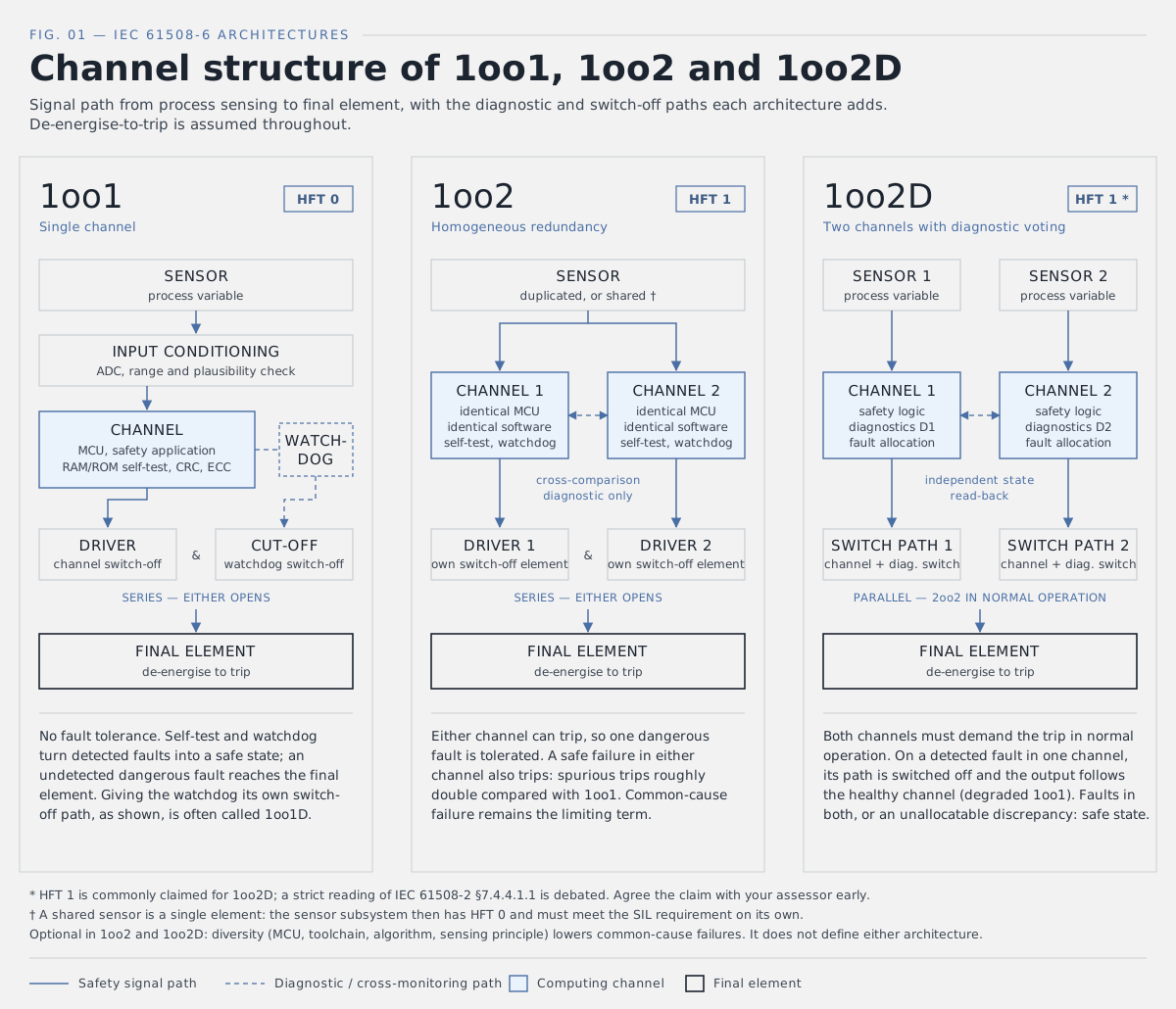
Redundancy architectures are named “MooN”: M out of N channels must demand the safety function for it to take place. IEC 61508-6 Annex B describes the reference architectures used to model hardware safety integrity. This page compares the three most common ones for embedded safety controllers.
1oo1 is a single channel. 1oo2 has two channels, either of which can trip. 1oo2D has two channels with diagnostic voting: they act together in normal operation and fall back to the healthy channel when a fault is detected.
The right choice depends on your target SIL, the safe failure fraction (SFF) your hardware can reach, the cost of a spurious trip, and your strategy against common-cause failure.
Each subsystem stands on its own. Sensor, logic and final element must independently meet both the architectural constraints and their share of the PFD/PFH budget. The function’s SIL is capped by the weakest link: a 1oo2 logic solver behind a single sensor is not a SIL 3 function.
Pattern comparison matrix
| Aspect | 1oo1 | 1oo2 | 1oo2D |
|---|---|---|---|
| Hardware fault tolerance (HFT) | 0 | 1 | 1, as commonly claimed * |
| Max SIL, Type B element, Route 1H | SFF < 60 %: not allowed 60 to < 90 %: SIL 1 90 to < 99 %: SIL 2 ≥ 99 %: SIL 3 | SFF < 60 %: SIL 1 60 to < 90 %: SIL 2 90 to < 99 %: SIL 3 ≥ 99 %: SIL 4 | As 1oo2, if HFT 1 is accepted |
| Dependence on diagnostics | High. Diagnostics raise SFF and turn detected faults into a safe state, but add no fault tolerance. | Moderate for fault tolerance — it does not rely on diagnostics. But the SIL ceiling still runs through SFF: SIL 3 at HFT 1 needs SFF ≥ 90 %, which on a Type B MCU demands serious diagnostic coverage. Diagnostics don’t change the voting; they still gate the achievable SIL. | Essential. Diagnostics decide the voting mode, so their coverage and speed govern both safety and availability. |
| Spurious trips | A safe failure of the channel trips the process. | Higher than 1oo1, roughly double for identical channels: a safe failure in either channel trips. | Lower than 1oo2. Both channels must demand the trip, and a detected fault leads to degraded operation instead of a trip. |
| Common-cause failure | Not applicable (no redundancy). | Quantified with a β-factor (IEC 61508-6 Annex D); reduced by separation, diversity and other measures. Note that two channels running identical software give no protection against a software fault: homogeneous redundancy addresses random hardware failures, not systematic ones. Only diversity (toolchain, algorithm, or independent implementation) reduces software common-cause. | As 1oo2. The cross-channel monitoring must also be independent of the channel it monitors. |
| Software complexity | Lowest | Moderate: synchronisation, cross-monitoring, discrepancy handling | Highest: fault allocation, voting reconfiguration, degraded-mode and re-integration logic |
Architectural constraints are one of three criteria for a SIL claim, alongside the PFD/PFH target and systematic capability. Microcontrollers are Type B elements. Route 2H, an alternative based on field reliability data, is not shown.
* A strict reading of IEC 61508-2 §7.4.4.1.1 leads some experts to classify 1oo2D as HFT 0. Agree the claim with your assessor early.
The three architectures in detail
1oo1 — single channel (HFT 0)
One channel (input, logic, output) performs the safety function, so a single dangerous failure causes its loss. On-line diagnostics such as a watchdog, memory tests or output read-back can detect faults and drive the output to the safe state. When they act through an independent switch-off path, the design is often called 1oo1D.
Advantages
- simplest hardware and software, and the easiest to analyse and certify
- lowest component count
- well suited when the target SIL is reachable with HFT 0
Disadvantages
- no fault tolerance
- for microcontroller-based hardware, SIL 2 needs an SFF of at least 90 % and SIL 3 at least 99 % (Route 1H)
- any safe failure trips the process
Typical use cases: SIL 1 and SIL 2 machinery and process functions with a modest risk-reduction requirement; protection functions in industrial equipment; smart field devices later combined into redundant arrangements at system level.
1oo2 — one out of two (HFT 1)
Two channels run in parallel and either can perform the safety function. With de-energise-to-trip outputs, each channel drives its own switch-off element and the two are wired in series, so either one opening removes power. The function is lost only if both channels fail dangerously. Cross-comparison between channels is a diagnostic: it reports faults but is not part of the switch-off path.
Advantages
- tolerates one dangerous hardware fault
- under Route 1H, allows one SIL higher than 1oo1 for the same SFF
- much lower PFD/PFH than a single channel, provided common-cause failures are controlled
Disadvantages
- a safe failure in either channel trips the process, so spurious trips roughly double compared with 1oo1
- common-cause failures limit the benefit and must be quantified
- more hardware, and more software for synchronisation, cross-monitoring and discrepancy handling
Typical use cases: SIL 3 process safety functions such as emergency shutdown, burner management and high-integrity pressure protection; two-channel machinery functions such as emergency stop and safe torque off; controllers where safety takes priority over availability.
1oo2D — one out of two with diagnostics (HFT 1 *)
As defined in IEC 61508-6, two channels are connected in parallel. In normal operation both must demand the safety function before it takes place. If the diagnostics in either channel detect a fault, the output voting adapts so the output follows the healthy channel, and the system runs as 1oo1 until repair. If both channels show faults, or a discrepancy cannot be allocated to either channel, the output goes to the safe state. Each channel can read the other’s state through a means independent of that channel.
The “D” stands for diagnostics, not diversity. Some manufacturers use “1oo2D” for other schemes, so always check the vendor’s definition.
Advantages
- combines fault tolerance with high availability
- a single safe failure does not trip the process
- a detected fault leads to degraded operation instead of a shutdown
Disadvantages
- safety depends heavily on diagnostic coverage, diagnostic test interval and the reliability of the switch-over
- IEC 61508-6 worked examples show a PFH better than 1oo1 but not as low as 1oo2
- the HFT 1 claim may be challenged by an assessor
- the most complex of the three to design, verify and assess
Typical use cases: continuous processes and machines where a spurious trip is costly or itself hazardous; safety PLCs and logic solvers designed for high availability; applications that must keep running in degraded mode for a defined repair time.
Summary
1oo1
Best for: lower-SIL functions, or high-SFF single-channel designs where simplicity matters.
Key trade-off: no fault tolerance; every safe failure is a trip.
1oo2
Best for: the highest safety integrity from two channels, such as SIL 3.
Key trade-off: roughly double the spurious trips of 1oo1; common-cause failure must be controlled.
1oo2D
Best for: high safety together with high availability.
Key trade-off: safety depends on diagnostic quality and switch-over; highest complexity; HFT claim to agree.
Choose the simplest architecture that meets your SIL requirement and your availability expectation. Related architectures worth knowing: 1oo1D, a single channel plus an independent diagnostic switch-off; and 2oo3, three channels where two must agree, tolerating one dangerous and one safe failure.
Recommended courses
Go deeper on the standard that governs the architecture you choose with our functional-safety training:
- IEC 61508 — Functional safety (the base standard for MooN architectures)
- ISO 26262 — Automotive functional safety
- ISO 13849 — Safety of machinery
- EN 50716 — Railway software / functional safety
- IEC 62304 — Medical device software
Regulatory and certification landscape
| Standard | How it relates to redundancy architectures |
|---|---|
| IEC 61508 (2010) | Generic functional safety standard. Part 2 sets the architectural constraints (HFT, SFF, Routes 1H and 2H); Part 6 gives the reference MooN architectures, PFD/PFH formulas and the β-factor method. It does not mandate a particular architecture. |
| EN IEC 62061:2021 | Machinery standard derived from IEC 61508, covering SIL 1 to 3. Applies HFT, diagnostic and common-cause concepts to machine control systems. |
| EN ISO 13849-1:2023 | Machinery standard based on Performance Levels (PL a to e) and designated architectures (Categories B, 1, 2, 3 and 4). Categories 3 and 4 are two-channel, with a minimum common-cause score of 65 points. |
| Regulation (EU) 2023/1230 | Applies from 20 January 2027. Sets outcome-based requirements (Annex III §1.2.1) without prescribing an architecture. Presumption of conformity comes from harmonised standards; EN ISO 13849-1 and EN IEC 62061 are the expected references. |
| ISO 26262 (2018) | Automotive; uses ASIL, not SIL. Hardware metrics (SPFM, LFM, PMHF) are in Part 5; ASIL decomposition across sufficiently independent redundant elements is in Part 9, Clause 5. |
| EN 50129:2018 | Railway signalling. Describes composite, reactive and inherent fail-safety and allows them to be combined. No architecture is mandated, though 2oo2-based composite designs are common at SIL 4. |