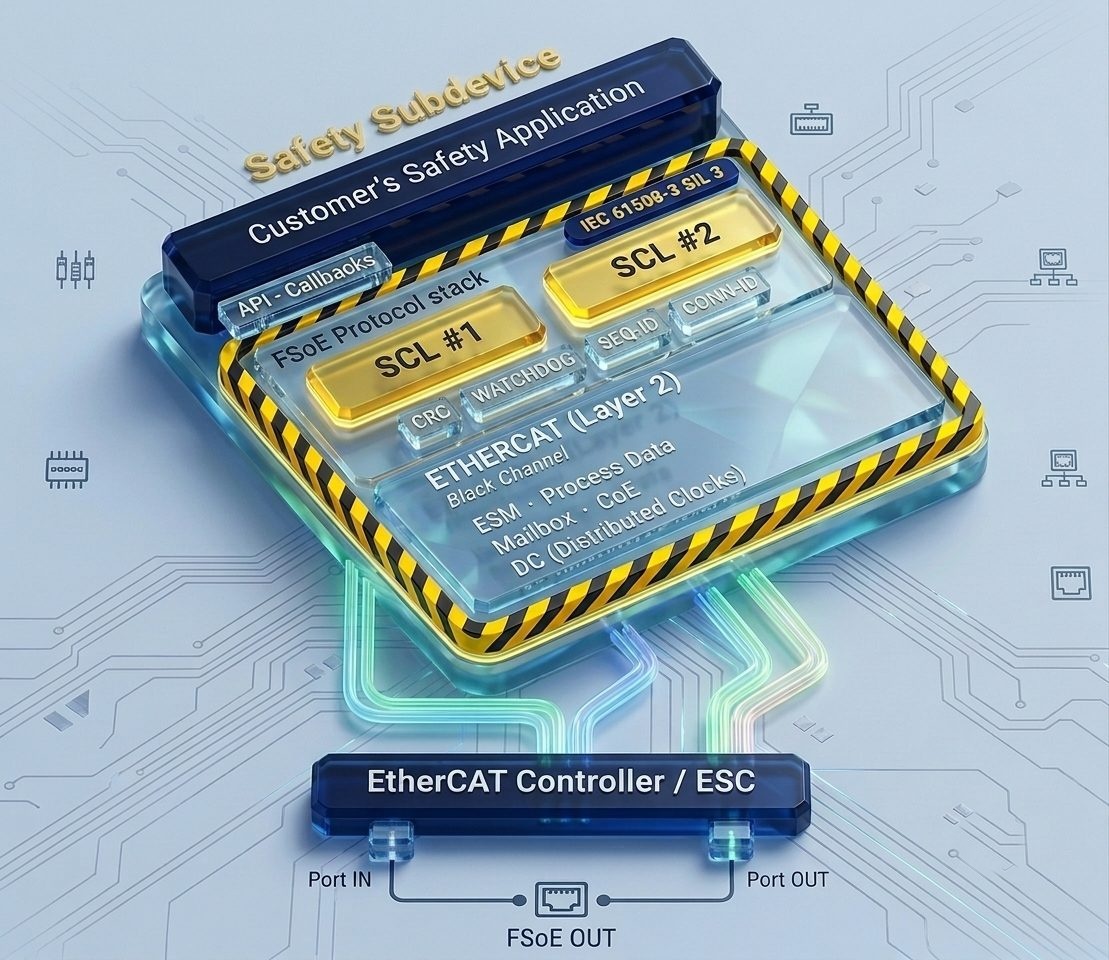
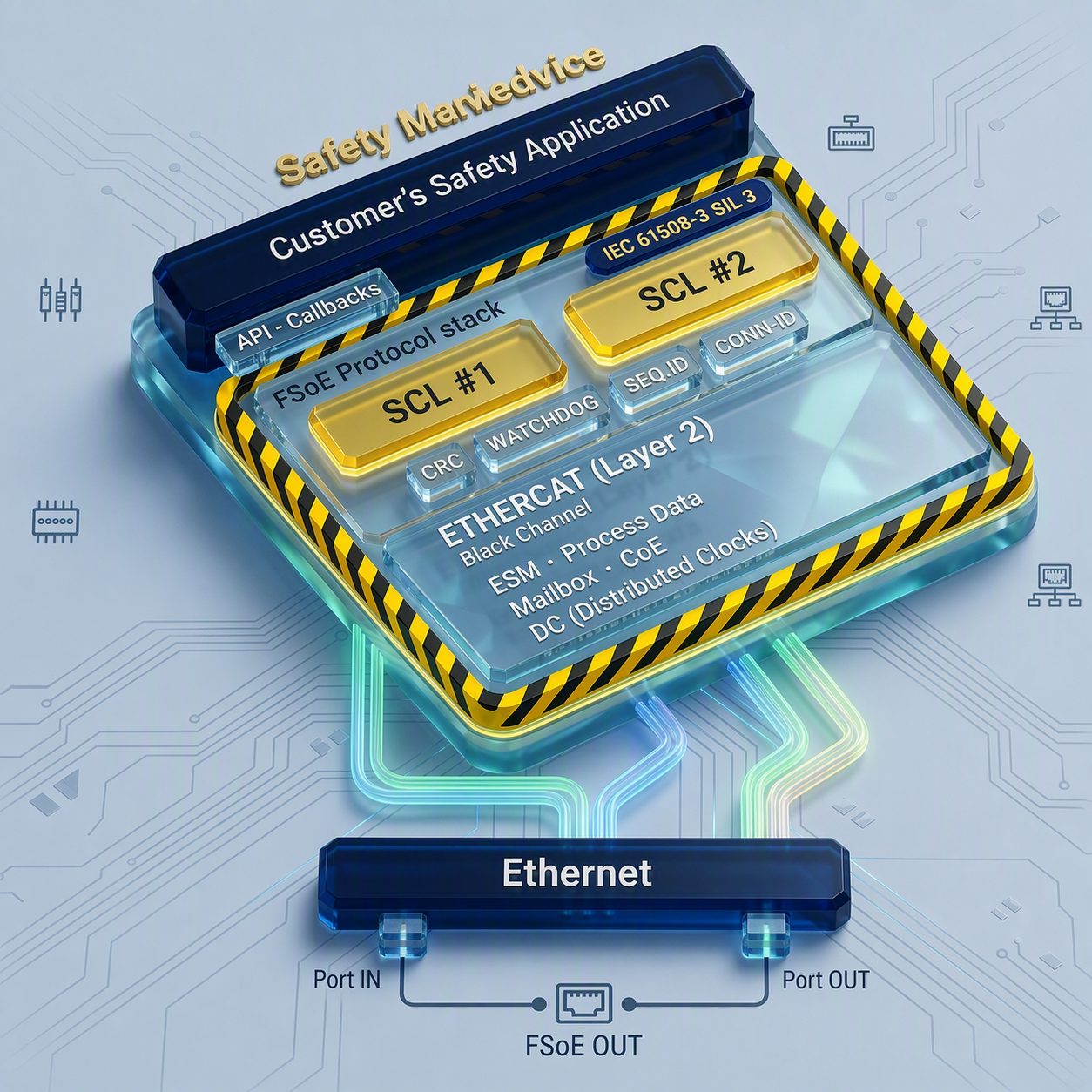
The FSoE master stack (FSoE MainInstance) brings the Fail-Safe over EtherCAT protocol to the controlling end of a safety network. Acting as the MainInstance, it sets up and continuously supervises safe links to one or more FSoE SubInstance (slave) devices, carrying safety-relevant process data with the integrity that functional safety demands.
How the FSoE MainInstance master works
On the controller side, the FSoE master stack opens each safe connection, applies its parameters and keeps watch over it — driving a dedicated FSoE state machine for every link and presenting safe inputs and outputs to your safety application through a documented API. By tracking watchdog timers, sequence numbers and connection identifiers, it catches any corrupted, lost or delayed safety frame and forces the affected connection into a safe state.
SIL3 integrity over a black channel
The stack follows the black-channel approach defined in IEC 61784-3: ordinary EtherCAT is treated as an untrusted carrier, and the FSoE layer wraps the data with its own CRC, connection identity and timing checks. Safe and standard traffic therefore share one EtherCAT network, while the safety layer alone reaches SIL3 / PLe — independently assessed by an independent certification body — so the transport itself never has to be certified.
Portable across any MCU, RTOS or bare metal
With no third-party dependencies, the FSoE MainInstance runs on practically any microcontroller, on any RTOS or on bare metal. It handles several safety connections at once and slots on top of most EtherCAT master stacks.
Where the FSoE master stack is used
Safety controllers, safety PLCs, safe motion controllers and industrial PCs rely on the FSoE master stack whenever they must open and monitor safe links to many devices at once. You’ll find it across machinery and robotics, factory and process automation, intralogistics and energy — anywhere a controller marshals safe I/O over EtherCAT in line with IEC 61508 and ISO 13849.
Standards and conformance
Engineered to IEC 61784-3 and assessed to SIL3 / PLe against IEC 61508 and ISO 13849.