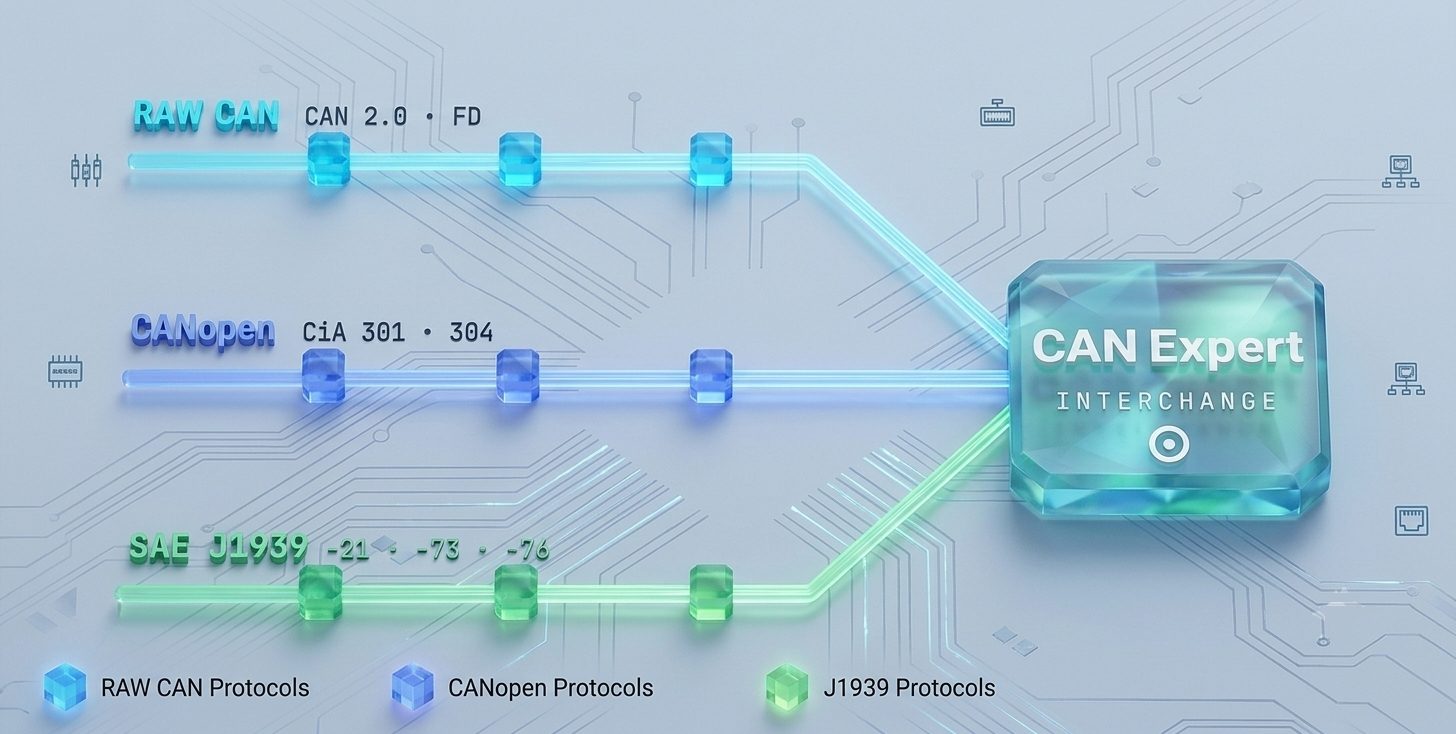
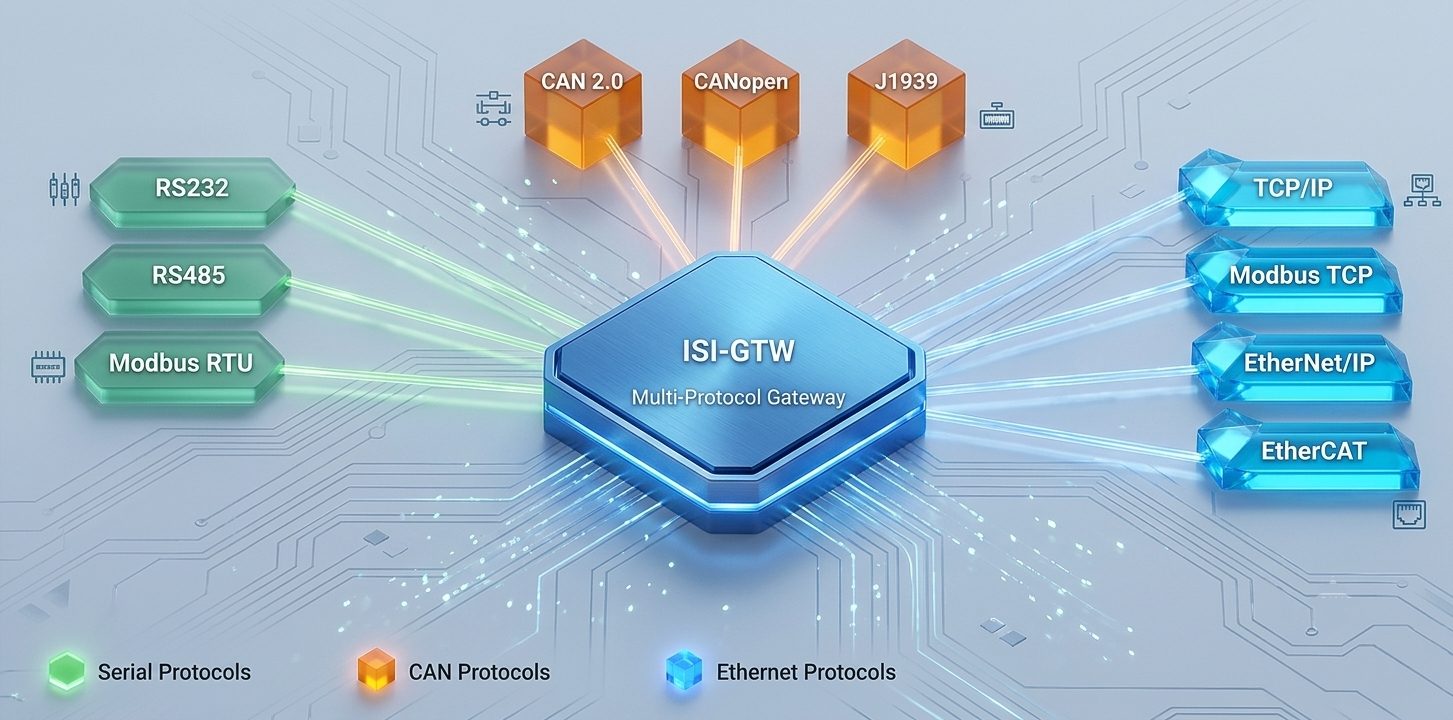
The multi-protocol gateway (ISI-GTW) connects devices and networks that speak different industrial protocols, so equipment that would otherwise be incompatible can exchange data in real time. It works as a configurable bridge between fieldbus and industrial-Ethernet networks — such as CANopen, EtherCAT and J1939 — with deterministic performance and built-in diagnostics.
Bridge incompatible networks
Machine builders and system integrators often need to connect a controller on one network to devices on another. The ISI-GTW multi-protocol gateway sits between the two sides and translates process data between them, removing the need for custom firmware or a redesign of existing equipment. Each side sees a native device on its own protocol.
Configurable data mapping
Data mapping is defined through configuration rather than code. You choose which process variables, objects or PDOs are exchanged between the two networks and how they are scaled and aligned, so the gateway can be adapted to a new machine or protocol combination without software development.
Real-time performance and diagnostics
The gateway is designed for deterministic, low-latency transfer, so it can sit inside control loops without adding jitter. Integrated diagnostics expose link status, data-exchange health and error counters, making the system straightforward to commission and to troubleshoot on either network during operation.
Typical applications
The ISI-GTW multi-protocol gateway is used to integrate drives, I/O and sensors across mixed installations: connecting CANopen devices to an EtherCAT master, bringing J1939 data from a vehicle or engine network into a factory controller, or linking legacy equipment to a modern industrial-Ethernet line during a retrofit.
Why choose the ISI-GTW gateway
Because it is built on ISIT’s own certified protocol stacks, the ISI-GTW multi-protocol gateway delivers reliable, standards-compliant communication on every port. It is configurable, diagnosable and backed by the engineering team that develops and certifies the underlying CANopen, EtherCAT and J1939 implementations — a single, supported source for the whole communication path.