Develop without hardware
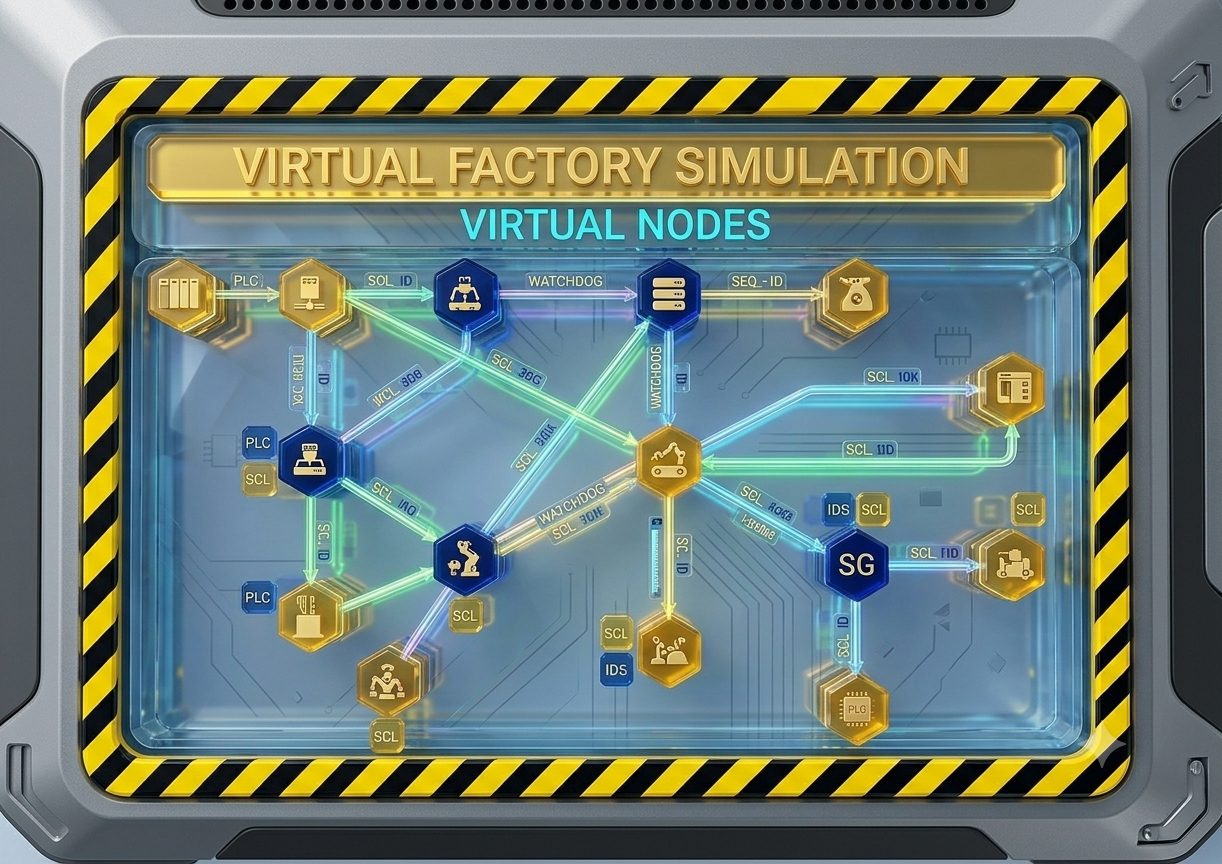
With FSoE network simulation you can work through a physical network adapter or entirely in software. Hardware-in-the-Loop (HiL) runs simulated devices on external hardware over a real cable, while Software-in-the-Loop (SiL) simulates the whole network on the same machine as your controller — no separate hardware or network interface — so it runs in a VM, in the cloud or in a CI/CD pipeline.Simulate faults and topologies
FSoE network simulation can emulate up to 2000 devices and inject realistic faults: device errors, state changes, cable breaks, frame loss and link loss at any point in the network. You can mix real and simulated devices to build a Digital Twin step by step, and reproduce hard-to-catch customer issues safely in-house.Protocols and Digital Twin
It covers EtherCAT (with distributed clocks and CoE/FoE/VoE/SoE mailboxes), CANopen, FSoE safety, CANopen Safety (SRDO) and J1939. Through the Functional Mock-up Interface (FMI), FSoE network simulation connects to Matlab, Simulink, Dymola and other tools using FMU models, so process data can be driven by a full plant model.API and delivery
A C/C++ and .NET API gives full control — change topology, device states, inject frame or link loss, and access registers, EEPROM and the object dictionary — ideal for automated test scripts. Compatible with ISIT-Neperis stacks, TwinCAT and CODESYS, FSoE network simulation accelerates master development, automated testing, virtual commissioning and firmware development well before hardware is available.Applications
FSoE network simulation is used for master and controller software development, automated regression testing in CI/CD, virtual commissioning with a Digital Twin, and device firmware development before hardware exists. It suits machine builders, device manufacturers and system integrators who want to develop, test and demonstrate EtherCAT, CANopen and FSoE systems independently of hardware availability.Platforms and compatibility
FSoE network simulation runs on Windows and Linux and offers a C/C++ and .NET API for full automation. It is compatible with ISIT-Neperis stacks, TwinCAT and CODESYS, and connects to Matlab, Simulink and Dymola through FMI/FMU models. Whether you run it fully in software or with a physical adapter, it reduces hardware cost, removes device-shortage bottlenecks and improves quality through repeatable, automated tests.FSoE Network Simulation is built on the Acontis EC-Simulator and extends it with a Safety-over-EtherCAT (FSoE) layer, so you can develop and validate FSoE master and slave devices entirely in software — no physical network required.