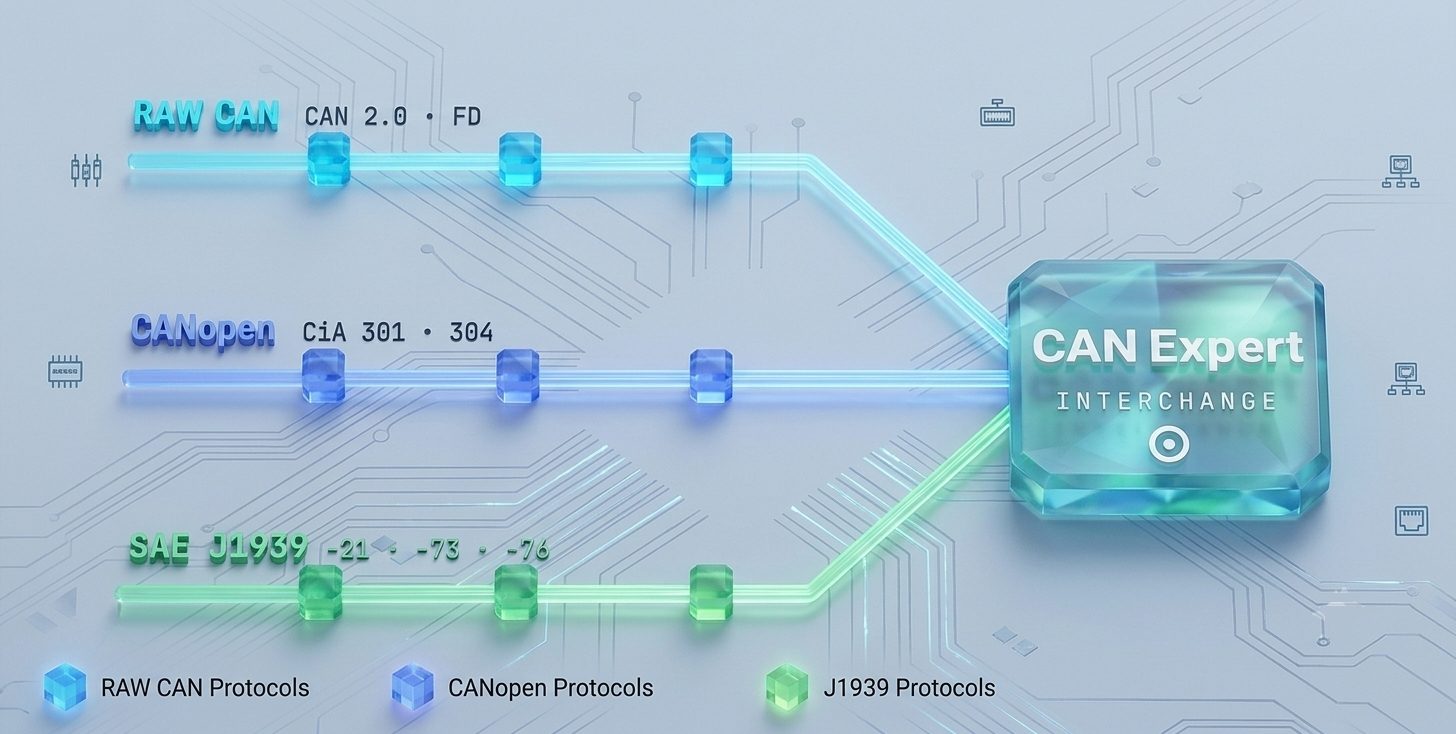

The CANopen master stack is a CiA 301 / 302 CANopen manager for controllers, PLCs and gateways. It brings up, configures and oversees an entire CANopen network — coordinating as many as 127 slave nodes through the full NMT, SDO and PDO service set on classic CAN or CAN FD.
Inside the CANopen master stack
In its NMT master role, the CANopen master stack boots the network and starts, stops and resets individual nodes, watching over them with heartbeat and legacy node-guarding. Its SDO client reads and writes parameters on any device; a Configuration Manager pushes DCF/EDS settings automatically at start-up; and PDO producers and consumers move real-time process data with freely configurable mapping. SYNC and TIME production keep every node marching in step.
Object Dictionary, EDS/DCF and LSS
Working straight from your EDS/DCF electronic data sheets (CiA 306), the stack commissions slaves without hand-coding, while a built-in LSS master (CiA 305) hands out node-IDs and bit rates directly over the bus. EMCY consumption with a stored error history turns device faults into clear, actionable diagnostics for the whole network.
Portable, hardware-independent CANopen
The CANopen master stack carries no third-party dependencies and runs on any MCU, any RTOS or bare metal. Because it covers both classic CAN 2.0A/B and CAN FD, a single code base scales from legacy buses to high-bandwidth designs — with no vendor lock-in.
Where the CANopen master stack fits
You’ll find the CANopen master stack in PLCs, motion and machine controllers, industrial PCs and gateways that have to configure and coordinate a CANopen network. It’s a natural fit for factory automation, off-highway and mobile machinery, medical devices, laboratory and building automation — anywhere one controller has to manage many CANopen devices over CAN or CAN FD.
Standards and conformance
The CANopen master stack implements the CiA specifications behind every CANopen manager: CiA 301 (application layer and communication profile), CiA 302 (network management and boot-up), CiA 305 (LSS) and CiA 306 (EDS). Driven by your EDS/DCF files, it commissions devices the same conformant way every time. It ships as a ready-to-integrate binary with a documented API and a sample application, backed directly by the engineers who wrote it.