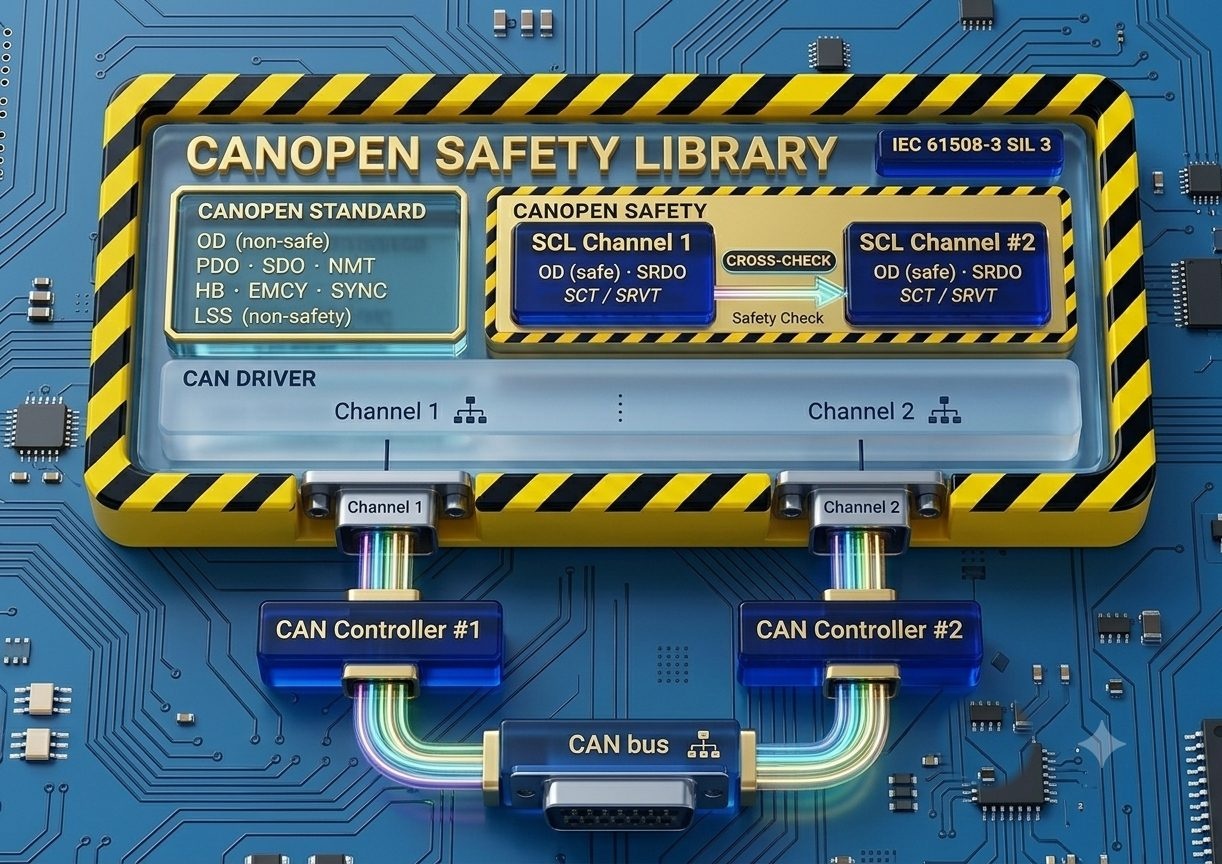
The CANopen Safety slave stack implements the CANopen Safety protocol (CiA 304 / EN 50325-5) on the device side of a safety network. It adds Safety-Related Data Objects (SRDOs) on top of standard CANopen so a device can exchange safe process data with the integrity required for functional safety, on the same CAN bus.
How the CANopen Safety slave stack works
Each SRDO carries the safety data twice — normal and bitwise-inverted — protected by a CRC and monitored with configurable Safeguard Cycle Time (SCT) and validation time (SRVT). If a timeout or a data mismatch occurs, the CANopen Safety slave stack drives the application to a safe state. It also supports the Global Failsafe Command (GFC) and a safety Object Dictionary with the SRDO communication and mapping parameters.
Runs alongside standard CANopen
The CANopen Safety slave stack coexists with the standard CANopen Slave stack on the same node and the same bus, so safe and non-safe data share one network. There is no need for a separate safety bus, which keeps device cost and wiring down while still reaching SIL3 / PLe integrity.
Portable and certification-ready
Delivered as a ready-to-integrate binary with a thin hardware abstraction layer, the CANopen Safety slave stack runs on any MCU, any RTOS or bare metal, with no third-party dependencies. It is assessed to SIL3 / PLe (IEC 61508 / ISO 13849) by an independent certification body and delivered with the safety manual and certification artefacts your own assessment requires.
Applications
The CANopen Safety slave stack suits safe sensors, safe actuators, safe drives and safe I/O modules that need to exchange safety data on a CANopen network. It is used in machinery, robotics, mobile and off-highway equipment, medical and process applications governed by IEC 61508 and ISO 13849, where a device must be both a standard CANopen node and a safety participant.
Standards and conformance
The CANopen Safety slave stack implements CiA 304 (EN 50325-5) for SRDO-based safety and is assessed to SIL3 / PLe under IEC 61508 and ISO 13849 by an independent certification body. Because it runs alongside the standard CANopen stack, you keep one bus and one wiring while adding a certified safety layer. It ships with the safety manual, certificate and test reports, and is supported by the engineers who developed and certified it.