Choosing an industrial communication protocol is one of the earliest and most consequential decisions in an embedded product. Change it late and you rework hardware, firmware and certification. The good news: a handful of questions narrow the field quickly.
Table of Contents
1. How much data, how fast?
Classic CAN-based buses (CAN, CANopen, J1939) are robust and cheap and cover most machine I/O at up to 1 Mbit/s. When you need higher throughput, tight synchronisation or many nodes, Industrial Ethernet (EtherCAT, PROFINET, EtherNet/IP) becomes the better fit.
2. What ecosystem must you plug into?
The controller or PLC on the other end often decides for you. PROFINET dominates Siemens environments, EtherNet/IP the Rockwell world, and EtherCAT is common in motion and test benches. In mobile machinery and vehicles, J1939 over CAN is the default.
3. What topology and cabling?
CAN is a simple two-wire bus; EtherCAT gives you line/ring topologies with minimal wiring and precise distributed clocks; PROFINET and EtherNet/IP ride standard Ethernet infrastructure.
4. Do you need functional safety?
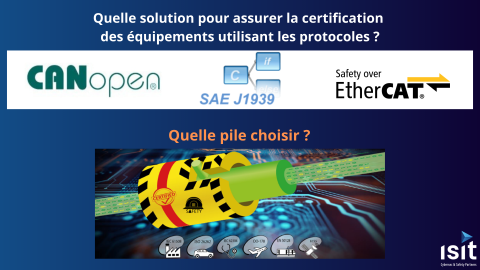
If safety data travels on the wire, you need a safety protocol layered on top: FSoE over EtherCAT, PROFIsafe over PROFINET, or CANopen Safety. This is where certification effort concentrates, so decide early.
5. Who owns the stack — and the certification evidence?
A stack you can only integrate as a black box becomes a liability at assessment time. ISIT-Neperis delivers stacks as full software with the documentation your certification needs, running on any MCU and any RTOS — so a protocol or hardware choice never locks you in.
Weighing options for a new device? Compare ISIT-Neperis protocol stacks or talk to our engineers.